
Butterfly valves are widely used throughout industrial pipework, water treatment, irrigation, manufacturing and engineering applications. They provide a reliable, compact and cost-effective method of controlling or isolating the flow of liquids and other compatible media.
Two of the most common designs are wafer butterfly valves and lugged & tapped butterfly valves. Although they operate in much the same way, there are important differences in their construction, installation and suitability for particular applications.
In this guide, T-mex Express explains the differences between wafer and lugged butterfly valves, their advantages, typical applications and how to select the correct valve for your pipework installation.
What Is a Butterfly Valve?
A butterfly valve is a quarter-turn valve used to regulate or isolate the flow of liquids, gases and other compatible media within a pipeline.
Inside the valve body is a circular disc mounted on a rotating shaft. Turning the valve handle or operating mechanism through 90 degrees moves the disc between its fully open and fully closed positions.
- Fully open: The disc is positioned approximately parallel to the direction of flow, allowing media to pass through the valve.
- Fully closed: The disc rotates perpendicular to the flow, creating a seal against the valve seat.
- Partially open: The valve can provide a degree of flow regulation, provided the valve is suitable for throttling service.
Butterfly valves are popular because they are lightweight, require relatively little installation space and can be operated quickly.
They are commonly available with lever handles, gearboxes, electric actuators and pneumatic actuators.
What Is a Wafer Butterfly Valve?
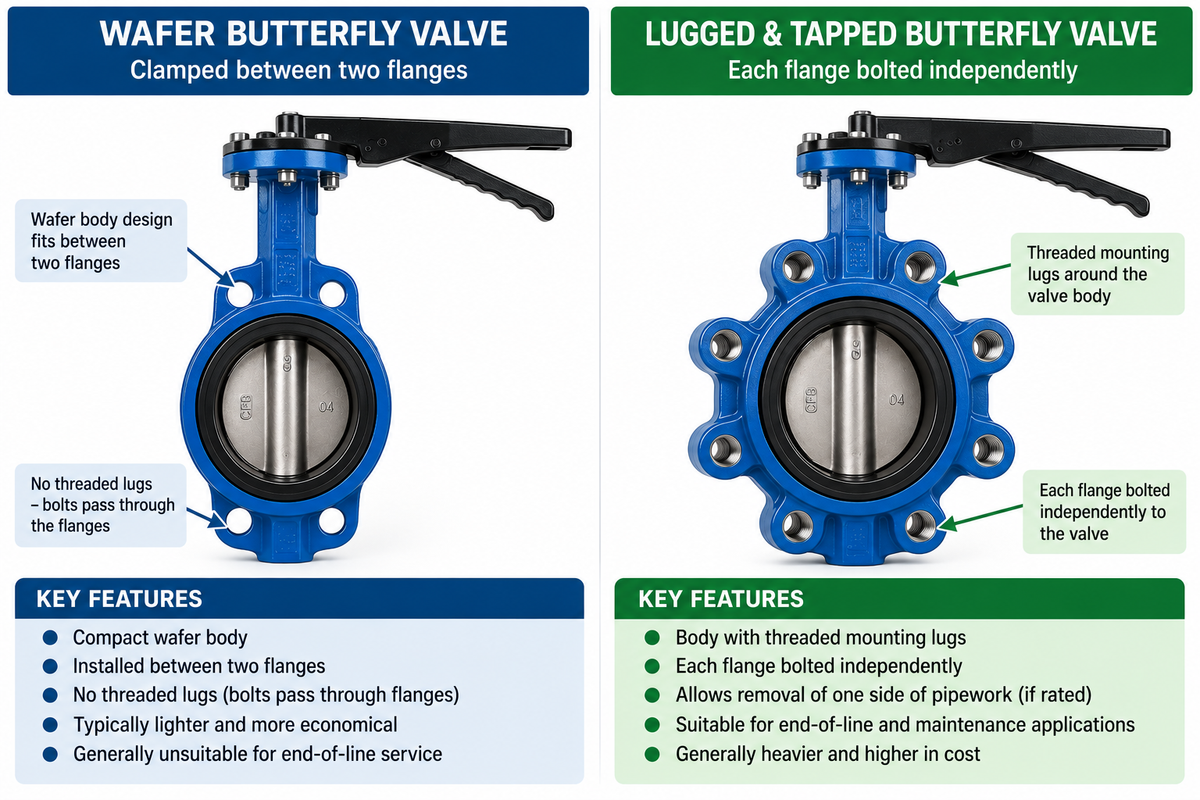
A wafer butterfly valve is designed to fit between two pipe flanges. The valve body is positioned between the flanges and secured using bolts or studs that clamp the assembly together.
Unlike a fully lugged valve, a conventional wafer butterfly valve does not have a complete set of individually threaded bolt holes around its body.
How Is a Wafer Butterfly Valve Installed?
The valve is placed between two compatible pipe flanges, with the flange bolts or studs passing around or through the valve body's locating features, depending on the design.
When the bolts are tightened correctly, the valve is securely clamped between the flanges.
Many resilient-seated butterfly valves incorporate an elastomeric liner that provides the flange-face seal, meaning separate flange gaskets may not be required. Always follow the manufacturer's installation instructions.
Advantages of Wafer Butterfly Valves
- Compact construction: Ideal for installations where space is limited.
- Lightweight design: Generally lighter than equivalent lugged butterfly valves.
- Cost-effective: Often less expensive than lugged alternatives of the same specification.
- Simple installation: Designed to fit between compatible pipe flanges.
- Wide availability: Commonly supplied for water distribution, irrigation and industrial applications.
Disadvantages of Wafer Butterfly Valves
The main limitation of a conventional wafer butterfly valve is that it generally requires flanges on both sides to maintain the clamped installation.
Removing one side of the connected pipework can compromise the valve's mounting arrangement. Therefore, standard wafer valves are generally unsuitable for applications requiring the downstream pipework to be removed while the upstream system remains pressurised.
For installations requiring this functionality, a suitably rated lugged butterfly valve may be more appropriate.
What Is a Lugged & Tapped Butterfly Valve?
A lugged butterfly valve, also referred to as a lugged & tapped butterfly valve, features threaded mounting lugs positioned around the valve body.
These threaded lugs allow the pipe flanges on either side of the valve to be bolted independently to the valve body.
This provides additional installation flexibility compared with a conventional wafer-style valve.
How Is a Lugged Butterfly Valve Installed?
Instead of using continuous bolts to clamp both flanges together, bolts are inserted through each pipe flange and screwed into the threaded lugs on the butterfly valve body.
Each flange can therefore be secured independently.
Depending on the manufacturer's design and pressure ratings, this arrangement can allow one section of pipework to be disconnected while the valve remains attached to the opposite flange.
Important: Not every lugged butterfly valve is suitable for pressurised dead-end service. The valve must be specifically approved for the intended end-of-line arrangement, pressure and flow direction.
Advantages of Lugged & Tapped Butterfly Valves
- Independent flange connections: Each side of the valve can be bolted separately.
- Maintenance flexibility: Can simplify removal or replacement of downstream pipework.
- Dead-end capability: Suitable models can be used for end-of-line isolation within their specified pressure limits.
- Secure installation: Threaded lugs provide individual flange mounting points.
- Industrial applications: Frequently selected for systems where maintenance access and isolation are important.
Disadvantages of Lugged Butterfly Valves
Lugged butterfly valves are generally heavier and more expensive than comparable wafer butterfly valves.
They also require correctly specified flange bolts, including suitable thread engagement and bolt lengths, to avoid damaging the threaded lugs.
Wafer vs Lugged Butterfly Valves: Comparison Table
The table below highlights the principal differences between these two common butterfly valve designs.
| Feature | Wafer Butterfly Valve | Lugged & Tapped Butterfly Valve |
|---|---|---|
| Body Design | Compact wafer body | Body with threaded mounting lugs |
| Installation | Clamped between two flanges | Each flange bolted independently |
| Bolting | Typically through-bolts or studs | Bolts into threaded lugs |
| Weight | Generally lighter | Generally heavier |
| Cost | Typically lower | Typically higher |
| Dead-End Service | Generally unsuitable | Possible if specifically rated |
| Maintenance | Usually requires both flanges to remain connected | Can allow independent pipework removal |
| Typical Applications | Water distribution, irrigation and general industrial pipework | Industrial isolation, maintenance-intensive systems and approved end-of-line installations |
Are Wafer and Lugged Butterfly Valves Interchangeable?
In some installations, a wafer butterfly valve can be replaced with a lugged butterfly valve, or vice versa, provided all relevant dimensions and specifications are compatible.
However, wafer and lugged butterfly valves should not automatically be considered interchangeable.
Before replacing an existing valve, check:
- Nominal valve diameter (DN).
- Flange drilling compatibility, such as PN10 or PN16.
- Valve face-to-face dimensions.
- Maximum working pressure.
- Operating temperature.
- Body, disc and seat materials.
- Required bolting arrangement.
- Available clearance for disc movement inside the adjoining pipework.
- Whether dead-end service is required.
It is particularly important to check the flange specification, as not every butterfly valve is suitable for every flange drilling pattern.
What Does PN16 Mean on a Butterfly Valve?
Many butterfly valves are described as PN10 or PN16 butterfly valves.
PN stands for nominal pressure and is used within European pressure-rating and flange standards.
For example, PN16 is a nominal pressure designation commonly associated with 16 bar-rated equipment at reference conditions.
However, the flange drilling designation and the actual valve pressure rating are not necessarily the same.
A butterfly valve may be designed to fit PN10 and PN16 flanges while having a maximum working pressure that differs from either designation.
Always check the manufacturer's stated pressure rating, temperature limits and flange compatibility before installation.
Where Are Butterfly Valves Commonly Used?
Both wafer and lugged butterfly valves are found across a wide range of engineering applications.
Water Distribution
Butterfly valves are commonly installed in water distribution networks, pumping stations and process pipework where compact isolation valves are required.
Agricultural Irrigation
In irrigation systems, butterfly valves can be used to isolate main pipelines, pump installations and individual sections of water distribution pipework.
Industrial Pipework
Manufacturing facilities frequently use butterfly valves to control or isolate compatible process fluids.
Water Treatment
Butterfly valves are widely used in water treatment plants, filtration systems and associated pipework installations.
Pumping Systems
Butterfly valves can provide isolation around pumps, strainers and other equipment, allowing maintenance when the system has been safely isolated and depressurised.
Which Butterfly Valve Should I Choose?
Choosing between a wafer and lugged butterfly valve depends primarily on the pipework arrangement and the intended application.
Choose a Wafer Butterfly Valve If:
- You require a compact and economical isolation valve.
- The valve will remain installed between two connected flanges.
- Dead-end service is not required.
- Weight and installation space are important considerations.
- You are installing general water, irrigation or compatible industrial pipework.
Choose a Lugged & Tapped Butterfly Valve If:
- You need independently bolted flange connections.
- Downstream pipework may need to be removed for maintenance.
- Your installation requires an approved end-of-line valve.
- You require greater flexibility when maintaining sections of pipework.
- The additional cost is justified by the installation requirements.
Our recommendation: For straightforward installations between two flanges, a wafer butterfly valve is often the most economical solution. Where independent flange connections or rated dead-end isolation are required, a lugged & tapped butterfly valve may be the better choice.
Frequently Asked Questions About Butterfly Valves
What is the main difference between a wafer and lugged butterfly valve?
The main difference is the mounting arrangement. A wafer butterfly valve is clamped between two pipe flanges, while a lugged butterfly valve has threaded mounting lugs that allow each flange to be bolted independently.
Can a wafer butterfly valve be used at the end of a pipeline?
Conventional wafer butterfly valves are generally not suitable for pressurised dead-end service. If end-of-line isolation is required, select a valve specifically rated and approved for that application.
Are lugged butterfly valves better than wafer butterfly valves?
Not necessarily. Lugged butterfly valves provide additional installation flexibility, but wafer butterfly valves are often lighter and more economical. The best choice depends on the pipework design and maintenance requirements.
Can butterfly valves be installed vertically?
Many butterfly valves can be installed in horizontal or vertical pipelines. However, installation orientation, shaft position and actuator requirements should always be checked against the manufacturer's instructions.
Do butterfly valves require flange gaskets?
Some resilient-seated butterfly valves use their integrated elastomeric liner to seal directly against the pipe flanges, eliminating the need for separate gaskets. Other valve designs may require gaskets. Always follow the manufacturer's recommendations.
Can a butterfly valve control flow?
Yes, butterfly valves can be used for flow regulation when designed and rated for throttling service. However, operating a valve partially open can increase turbulence, pressure loss and wear. For precise flow control, a dedicated control valve may be more appropriate.
What sizes are butterfly valves available in?
Butterfly valves are manufactured in a wide range of nominal diameters, from relatively small industrial pipework sizes to large water distribution pipelines. Availability depends on the manufacturer, valve material and pressure rating.
Butterfly Valves from T-mex Express
At T-mex Express, we supply engineering valves, pipe fittings and associated components for industrial, commercial, agricultural and water distribution applications throughout the UK.
Whether you are replacing an existing butterfly valve or specifying components for a new pipework installation, selecting the correct valve body, flange compatibility and pressure rating is essential.
Our experienced team can help you identify suitable products for your application.
Need Help Choosing a Butterfly Valve?
Not sure whether you need a wafer or lugged & tapped butterfly valve?
Contact T-mex Express with your required valve size, flange specification, working pressure and application. Our team will be happy to help you select a suitable valve.
Industrial valves, pipe fittings and engineering components available for UK delivery.