
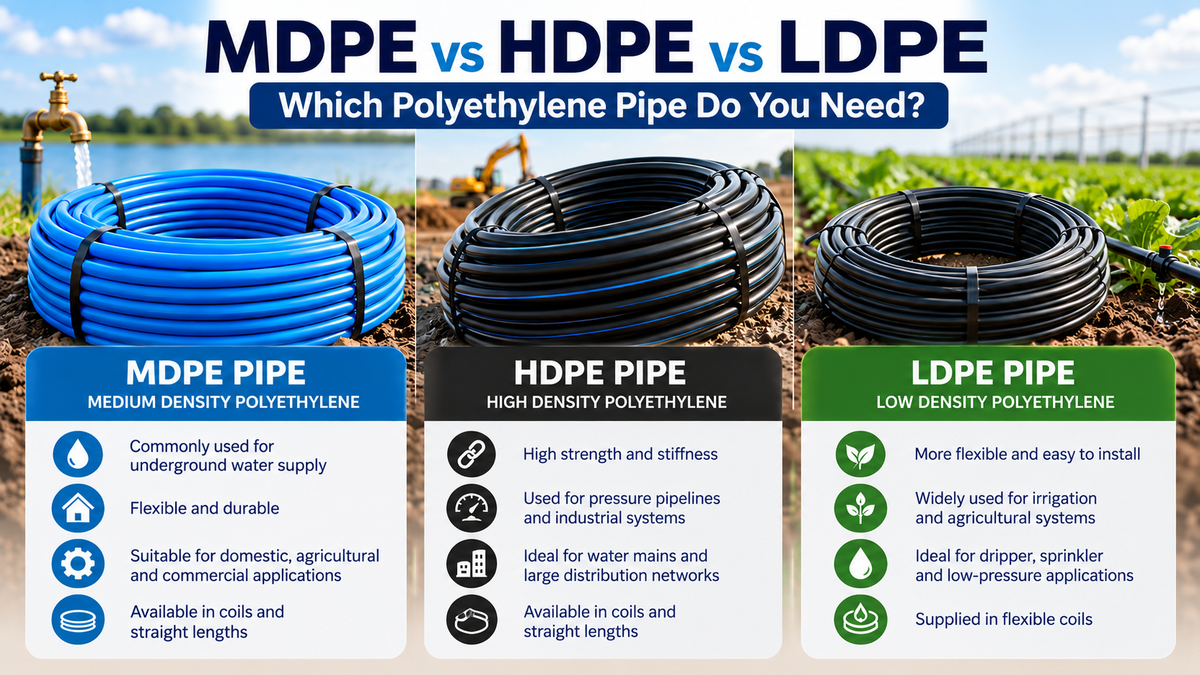
Choosing the correct polyethylene pipe is essential for any water supply, irrigation, agricultural or industrial pipework installation. Three of the most commonly encountered types are MDPE pipe, HDPE pipe and LDPE pipe. Although all three are manufactured from polyethylene, they have different material characteristics and are commonly used for different applications.
Understanding the difference between MDPE vs HDPE vs LDPE can help you select the correct pipe for your project, whether you are installing an underground water main, designing an irrigation system, or connecting industrial pipework.
MDPE (Medium Density Polyethylene) is widely used for underground water supply and distribution pipework. HDPE (High Density Polyethylene) is commonly used for pressure pipelines, industrial systems and larger water distribution networks. LDPE (Low Density Polyethylene) is generally more flexible and is frequently used for agricultural irrigation, dripper systems and low-pressure water distribution.
The correct choice depends on the pipe's material grade, pressure rating, dimensions, operating temperature and intended application.
What Is Polyethylene (PE) Pipe?
Polyethylene pipe, commonly known as PE pipe, is a thermoplastic pipe used extensively throughout the water supply, agricultural irrigation, construction and industrial sectors.
Polyethylene pipe is popular because it offers excellent corrosion resistance, flexibility and a relatively low weight compared with many traditional metal pipe systems.
Depending on the material grade and pipe specification, polyethylene pipe can be used for:
- Underground potable water supply
- Agricultural irrigation systems
- Commercial water distribution
- Industrial process pipework
- Water mains and service connections
- Landscape irrigation
- Greenhouse and horticultural installations
- Selected drainage and wastewater applications
At T-mex Express, we supply a range of polyethylene PE pipe and PE tubing for agricultural, commercial and industrial applications.
MDPE vs HDPE vs LDPE – Comparison Table
The table below compares the main characteristics and typical applications of MDPE, HDPE and LDPE pipe.
| Feature | MDPE Pipe | HDPE Pipe | LDPE Pipe |
|---|---|---|---|
| Full Name | Medium Density Polyethylene | High Density Polyethylene | Low Density Polyethylene |
| Material Density | Medium | High | Low |
| Flexibility | Flexible | Generally stiffer than MDPE | Generally the most flexible |
| Typical Applications | Water supply and service pipes | Water mains and industrial pipelines | Irrigation and agricultural tubing |
| Common Material Grades | PE80 and other specified grades | PE100 and PE100-RC | LDPE grades specified by the manufacturer |
| Pressure Ratings | Dependent on PE grade and SDR | Dependent on PE grade and SDR | Dependent on product specification |
| Common Supply Format | Coils and straight lengths | Coils and straight lengths | Flexible coils |
| Typical Fittings | Compatible compression and fusion fittings | Compatible compression and fusion fittings | Irrigation connectors and insert fittings |
What Is MDPE Pipe?
MDPE stands for Medium Density Polyethylene. MDPE pipe is widely used throughout the UK for underground water supply, domestic service connections, agricultural water distribution and commercial pipework.
One of the most recognisable products is blue MDPE water pipe, commonly used for potable water supply installations.
Blue MDPE pipe is available in a range of outside diameters and is frequently supplied in coils, making it suitable for underground installations where long continuous pipe runs are required.
Common Uses for MDPE Pipe
- Underground mains water connections
- Domestic water service pipes
- Agricultural water supplies
- Farm buildings and livestock water systems
- Commercial water distribution
- Water supply to outbuildings
- Underground cold-water pipework
What Colour Is MDPE Water Pipe?
In the UK, blue polyethylene water pipe is commonly used to identify potable water supply pipework. Black polyethylene pipe is also used in water and industrial applications, depending on its specification.
However, pipe colour should not be treated as proof of drinking-water suitability. Always verify the pipe's markings, relevant standards and drinking-water approvals for the intended installation.
Shop Blue MDPE Water Pipe
Looking for blue MDPE pipe for an underground water supply installation? Explore our range of blue MDPE pipe coils, suitable for appropriately specified water distribution applications.
Shop Blue MDPE Pipe CoilsWhat Is HDPE Pipe?
HDPE stands for High Density Polyethylene. HDPE pipe is extensively used for water distribution, industrial pipework, infrastructure projects and agricultural water systems.
HDPE materials generally offer greater stiffness than lower-density polyethylene materials. However, the pressure capability of a finished pipe depends on its material classification, wall thickness and design specification.
Many modern pressure pipe systems use PE100 HDPE pipe, which offers a high minimum required strength classification and is widely specified for pressure pipeline applications.
Common Uses for HDPE Pipe
- Water distribution mains
- Industrial water pipelines
- Agricultural irrigation mains
- Commercial pipework installations
- Infrastructure and civil engineering projects
- Selected wastewater and drainage systems
- Pressure pipe systems using electrofusion or butt fusion joints
What Is PE100 HDPE Pipe?
PE100 is a polyethylene material classification commonly used for modern pressure pipe systems.
PE100 has a minimum required strength classification of 10 MPa at 20°C over a 50-year reference period under the applicable testing methodology.
This does not mean that every PE100 pipe has the same working pressure. The pipe's pressure rating also depends on its SDR (Standard Dimension Ratio) and the relevant design conditions.
What Is LDPE Pipe?
LDPE stands for Low Density Polyethylene. LDPE pipe and tubing are widely used in agricultural irrigation, horticulture, landscaping and low-pressure water distribution.
LDPE is generally more flexible than MDPE and HDPE materials, making it particularly useful for installations where tubing must follow curved routes or connect to individual irrigation outlets.
Common Uses for LDPE Pipe
- Drip irrigation systems
- Strawberry and raspberry irrigation
- Greenhouse irrigation
- Horticultural watering systems
- Landscape irrigation
- Micro-irrigation systems
- Agricultural dripper and sprinkler connections
LDPE irrigation tubing is commonly available in sizes such as 16 mm, 20 mm and 25 mm, although the available sizes and pressure ratings vary by manufacturer.
For irrigation applications, always check the tubing's pressure rating and compatibility with the selected drippers, connectors and other irrigation components.
Shop LDPE and PE Irrigation Tubing
Browse polyethylene tubing for agricultural irrigation, horticulture and water distribution.
Shop PE TubingMDPE vs HDPE – Which Is Stronger?
When comparing MDPE vs HDPE pipe, HDPE materials generally have a higher density and stiffness than MDPE materials.
However, this does not automatically mean that every HDPE pipe has a higher working pressure than every MDPE pipe.
For pressure pipework, the actual performance depends on factors including:
- Polyethylene material classification
- Pipe outside diameter
- Pipe wall thickness
- SDR classification
- Operating temperature
- Intended service conditions
- Relevant manufacturing standards
For example, a PE100 pipe with a thicker wall may have a higher pressure rating than a PE80 pipe of the same outside diameter.
The correct pipe should always be selected using its published technical specification rather than material density alone.
What Is the Difference Between PE80 and PE100 Pipe?
Two commonly encountered polyethylene pressure pipe material classifications are PE80 and PE100.
These classifications relate to the long-term hydrostatic strength of the polyethylene material.
| Specification | PE80 | PE100 |
|---|---|---|
| Minimum Required Strength | 8 MPa | 10 MPa |
| Common Applications | Water service and distribution pipes | Water mains and pressure pipelines |
| Pressure Capability | Depends on SDR | Depends on SDR |
| Material Classification | PE80 | PE100 |
PE100 has a higher minimum required strength classification than PE80. This can allow a PE100 pipe to achieve a higher pressure rating at the same SDR, subject to the applicable design standard.
What Does SDR Mean on Polyethylene Pipe?
SDR stands for Standard Dimension Ratio. It describes the relationship between the outside diameter of a pipe and its nominal wall thickness.
The calculation is:
For pipes with the same outside diameter, a lower SDR generally indicates a thicker pipe wall.
For example:
- SDR11: Thicker wall relative to outside diameter
- SDR17: Thinner wall relative to outside diameter
For pipes manufactured from the same material grade, a lower SDR will generally provide a higher pressure rating.
Common Polyethylene Pipe Sizes
Polyethylene pressure pipes are commonly specified using their outside diameter (OD).
This is important because pipe fittings must match the actual outside diameter of the pipe.
| Nominal PE Pipe Size | Outside Diameter | Typical Applications |
|---|---|---|
| 20 mm | 20 mm | Small water connections and irrigation |
| 25 mm | 25 mm | Domestic water services |
| 32 mm | 32 mm | Water supply and agricultural distribution |
| 40 mm | 40 mm | Commercial and agricultural water supply |
| 50 mm | 50 mm | Water distribution systems |
| 63 mm | 63 mm | Commercial water mains and irrigation |
| 75 mm | 75 mm | Water distribution pipelines |
| 90 mm | 90 mm | Water mains and industrial applications |
| 110 mm | 110 mm | Water mains and infrastructure |
| 160 mm | 160 mm | Large water distribution systems |
Can You Use the Same Fittings for MDPE and HDPE Pipe?
In many installations, MDPE and HDPE pressure pipes can use compatible mechanical compression fittings, provided the pipe and fitting meet the manufacturer's dimensional and application requirements.
However, fitting compatibility should never be assumed based solely on pipe outside diameter.
Important factors include:
- Pipe outside diameter
- Pipe wall thickness and SDR
- Pipe material classification
- Operating pressure
- Fitting manufacturer's approval
- Whether pipe liners or inserts are required
Electrofusion and butt fusion connections also require compatible pipe and fitting materials, suitable equipment and approved installation procedures.
LDPE irrigation tubing often uses different insert fittings, barbed connectors or irrigation compression fittings specifically designed for the tubing dimensions.
Which Pipe Is Best for Underground Water Supply?
For many UK underground potable water service installations, blue MDPE water pipe is a commonly specified solution.
The pipe must be suitable for drinking-water applications and comply with the relevant standards and water supplier requirements.
For larger water distribution systems, PE100 pressure pipe is also widely used.
The final selection should consider operating pressure, installation conditions, pipe dimensions, drinking-water approval and the requirements of the local water undertaker.
Explore our blue MDPE pipe coils for water supply applications.
Which Polyethylene Pipe Is Best for Irrigation?
The most suitable pipe for an irrigation system depends on the required flow rate, working pressure and installation layout.
For larger irrigation mains, MDPE or HDPE pressure pipe may be appropriate.
For smaller distribution lines and dripper systems, LDPE irrigation tubing is commonly used because of its flexibility and ease of installation.
Agricultural irrigation systems may combine several different polyethylene pipe types within the same installation.
For example, a larger PE pressure pipe may supply water to a network of smaller LDPE irrigation laterals.
Frequently Asked Questions About MDPE, HDPE and LDPE Pipe
Is MDPE the same as HDPE?
No. MDPE stands for Medium Density Polyethylene, while HDPE stands for High Density Polyethylene. They have different material characteristics and may be manufactured to different pipe specifications.
Can HDPE pipe be used for drinking water?
Yes, suitably manufactured and approved HDPE pipe can be used for drinking-water supply. Always verify that the specific pipe meets the applicable potable-water requirements and standards.
Is LDPE pipe suitable for mains water pressure?
LDPE irrigation tubing should not automatically be used for mains water installations. Its suitability depends on the manufacturer's pressure rating, relevant standards and approval for the intended application.
What is the difference between blue and black MDPE pipe?
Blue polyethylene pipe is commonly used for potable water supply in the UK, while black polyethylene pipe is used across various water and industrial applications. The correct specification and approval must always be checked.
Is PE100 stronger than PE80?
PE100 has a higher minimum required strength classification than PE80. However, the working pressure of a finished pipe depends on its SDR and design specification.
Can you connect MDPE pipe to LDPE pipe?
Yes, it may be possible to connect MDPE pressure pipe to LDPE irrigation tubing using a suitable transition fitting. The fitting must be compatible with both pipe dimensions and the operating pressure.
What does PN16 mean on polyethylene pipe?
PN16 is a nominal pressure classification associated with 16 bar under the applicable reference conditions. Actual suitability depends on the pipe material, temperature, service conditions and relevant product standard.
Buy MDPE, HDPE and LDPE Pipe Online at T-mex Express
At T-mex Express, we supply polyethylene pipe and tubing for engineering, agricultural irrigation, commercial water distribution and industrial applications.
Whether you require blue MDPE water pipe, polyethylene pressure pipe or flexible irrigation tubing, our range provides solutions for a wide variety of pipework installations.
With an extensive engineering product range and UK delivery options, T-mex Express helps customers source the pipework components they need.
Explore Our Polyethylene Pipe Range
Browse our available pipe and tubing products below.
Shop PE Pipe Shop PE Tubing Shop Blue MDPE CoilsNeed help selecting the correct polyethylene pipe? Contact the T-mex Express team for assistance with pipe sizes, pressure ratings, material specifications and compatible fittings.