
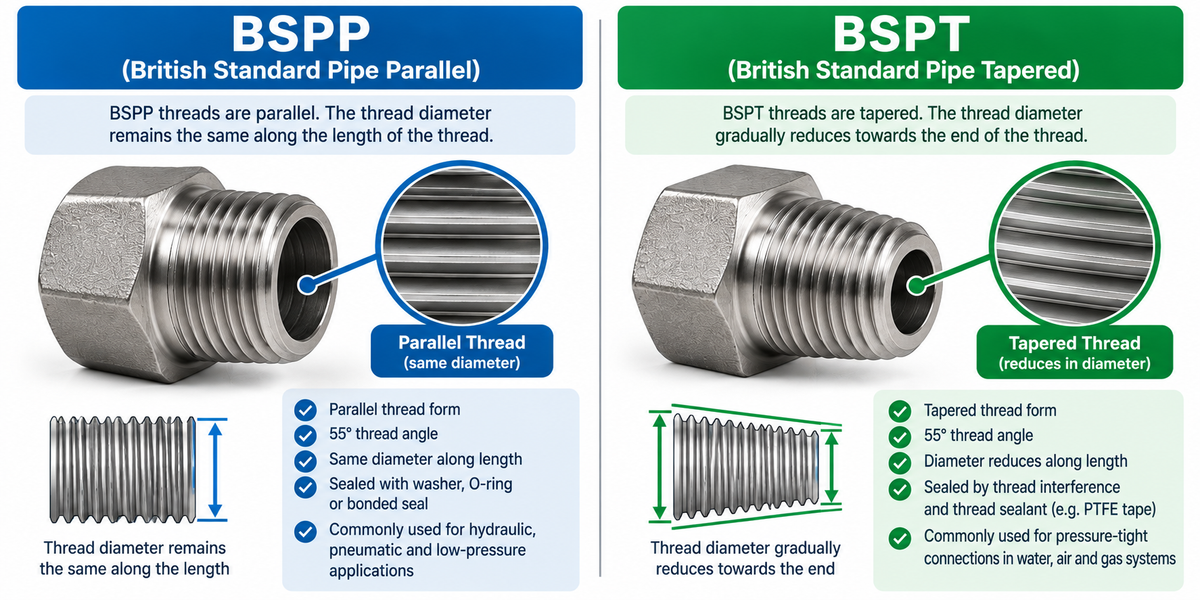
BSPP vs BSPT Threads – What's the Difference?
When selecting pipe fittings, valves, adaptors and threaded connectors, understanding the difference between BSPP and BSPT threads is essential. Although both are types of British Standard Pipe (BSP) threads, they have different thread profiles and sealing requirements.
The main difference is simple: BSPP threads are parallel, while BSPT threads are tapered. BSPP threads maintain a constant diameter along their length, whereas BSPT threads gradually change in diameter, creating a tighter mechanical fit as the connection is assembled.
Both thread types are widely used throughout the UK in plumbing, industrial pipework, irrigation systems, pneumatic equipment, hydraulic connections and engineering applications. However, they are not automatically interchangeable.

What Does BSP Stand For?
BSP stands for British Standard Pipe, a family of pipe thread standards widely used in the United Kingdom and internationally.
BSP threads are commonly found on pipe fittings, valves, pumps, pressure gauges, manifolds, hose connectors and industrial equipment.
There are two principal BSP thread forms:
- BSPP – British Standard Pipe Parallel: Parallel threads with a constant diameter.
- BSPT – British Standard Pipe Taper: Tapered threads designed for suitable pressure-tight threaded connections.
Both thread forms use a 55-degree Whitworth thread profile, but the thread geometry and sealing arrangements differ.
What Is a BSPP Thread?
BSPP (British Standard Pipe Parallel) threads are also commonly referred to as G threads. They are standardised under ISO 228.
A BSPP thread has a constant diameter along its length. This means the thread does not become progressively tighter simply because of a taper.
BSPP connections commonly achieve a pressure-tight seal using a separate sealing component rather than relying on the threads themselves.
How Do BSPP Threads Seal?
Depending on the fitting design, BSPP connections may use:
- Flat sealing washers.
- Bonded sealing washers.
- O-rings.
- Suitable face-sealing arrangements.
The sealing method depends on the specific fitting, mating component and application.
Where Are BSPP Threads Used?
BSPP threads are commonly found in:
- Hydraulic fittings and adaptors.
- Pneumatic equipment and air systems.
- Pressure gauges and instrumentation.
- Industrial valves and pipe fittings.
- Hose connectors and hydraulic components.
- Water distribution equipment.
For example, a 1/2" BSPP male fitting may use a bonded washer or another suitable sealing arrangement to form a pressure-tight connection.
What Is a BSPT Thread?
BSPT (British Standard Pipe Taper) threads are tapered pipe threads commonly associated with ISO 7-1 and EN 10226 thread specifications.
Unlike BSPP, a BSPT thread changes diameter along its length. On a typical male BSPT fitting, the external thread diameter gradually reduces towards the end of the fitting.
As the tapered male thread is tightened into a compatible female threaded connection, the thread geometry creates an interference fit.
How Do BSPT Threads Seal?
BSPT threaded connections are designed for sealing on the threads, normally with a suitable thread sealing compound or sealing tape where required by the manufacturer.
Common sealing materials include:
- PTFE thread sealing tape.
- Suitable liquid thread sealants.
- Approved pipe jointing compounds.
Always follow the fitting manufacturer's instructions, particularly when working with plastic threaded fittings, where excessive tightening can cause damage.
Where Are BSPT Threads Used?
BSPT threads are widely used in:
- Industrial pipework installations.
- Stainless steel threaded fittings.
- Brass pipe fittings and adaptors.
- Compressed air systems.
- Water supply and distribution.
- Compatible threaded valve connections.
- Industrial pumps and machinery.
BSPP vs BSPT – Key Differences
The following table compares the main technical differences between BSP parallel and BSP tapered threads.
| Feature | BSPP | BSPT |
|---|---|---|
| Full Name | British Standard Pipe Parallel | British Standard Pipe Taper |
| Thread Shape | Parallel | Tapered |
| Thread Diameter | Constant along length | Changes along length |
| Thread Angle | 55° | 55° |
| Typical Standard | ISO 228-1 | ISO 7-1 |
| Common Designation | G | R (male), Rc (female tapered) |
| Sealing Method | Usually washer, O-ring or face seal | Thread interference with suitable sealant |
| Typical Applications | Hydraulics, pneumatics, instrumentation | Industrial pipework, water and compressed air |
BSP Thread Size Chart – Dimensions in Millimetres
One of the most common mistakes when identifying BSP threads is assuming that the nominal thread size represents the actual outside diameter.
For example, a 1/2" BSP thread does not measure 12.7mm across its outside diameter. Its nominal major diameter is approximately 20.96mm.
The table below shows common BSP thread sizes, nominal major diameters and threads per inch (TPI).
| BSP Thread Size | Nominal Major Diameter (mm) | Threads Per Inch (TPI) |
|---|---|---|
| 1/8" | 9.73 | 28 |
| 1/4" | 13.16 | 19 |
| 3/8" | 16.66 | 19 |
| 1/2" | 20.96 | 14 |
| 3/4" | 26.44 | 14 |
| 1" | 33.25 | 11 |
| 1 1/4" | 41.91 | 11 |
| 1 1/2" | 47.80 | 11 |
| 2" | 59.61 | 11 |
| 2 1/2" | 75.18 | 11 |
| 3" | 87.88 | 11 |
| 4" | 113.03 | 11 |
Note: Dimensions shown are nominal reference major diameters. Actual measured dimensions depend on thread tolerances and, for tapered threads, the measurement position.
Can BSPP and BSPT Threads Be Connected Together?
This is one of the most frequently asked questions when selecting BSP threaded pipe fittings.
The answer depends on the thread designation, connection design and sealing arrangement.
Under ISO 7-1, a tapered male R thread may be designed to connect with a compatible parallel female Rp thread. This is a recognised pressure-tight threaded joint arrangement.
However, an ISO 228 BSPP G thread is not automatically interchangeable with an ISO 7 tapered thread simply because the nominal size and thread pitch appear similar.
Important: Always verify the manufacturer's specified thread compatibility and sealing method. A connection that screws together is not necessarily suitable for pressure service.
How to Identify BSPP and BSPT Threads
If you are unsure whether a fitting has a BSPP or BSPT thread, several checks can help identify the connection.
1. Check the Thread Markings
Look for thread designations on the fitting, packaging or technical data sheet.
- G: Generally identifies an ISO 228 BSPP parallel thread.
- R: Identifies an ISO 7 tapered male thread.
- Rc: Identifies an ISO 7 tapered female thread.
- Rp: Identifies an ISO 7 parallel female thread intended for suitable pressure-tight threaded joints.
2. Measure the Thread Diameter
Use a suitable vernier caliper to measure the thread diameter at different points.
On a male BSPP fitting, the thread diameter should remain approximately constant. On a male BSPT fitting, the diameter changes along the threaded section.
3. Check the Thread Pitch
A thread pitch gauge can help identify the number of threads per inch.
Both BSPP and BSPT use the same nominal thread pitch for corresponding BSP sizes, so thread pitch alone cannot distinguish parallel from tapered threads.
4. Confirm the Sealing Arrangement
Inspect the fitting for a sealing face, washer, O-ring or other designed sealing feature. These can provide useful clues about the intended connection type.
Where identification remains uncertain, consult the manufacturer's technical data or use appropriate thread gauges.
BSP Threads in PVC, Brass and Stainless Steel Fittings
BSP threaded connections are available in a wide range of materials, each suited to different operating environments.
PVC-U Threaded Fittings
PVC-U threaded pipe fittings are commonly used in water treatment, irrigation, swimming pools and industrial fluid handling.
Plastic threaded connections require particular care during installation. Excessive tightening, unsuitable sealants or incompatible mating threads may damage the fitting.
Stainless Steel BSP Fittings
Stainless steel BSP fittings, including Grade 316 threaded fittings, are widely used in industrial pipework where strength and corrosion resistance are important.
Common products include threaded elbows, tees, sockets, unions, nipples, bushes, caps and plugs.
Brass BSP Fittings
Brass BSP fittings are commonly used in plumbing, water distribution, compressed air and general engineering.
Always select fittings according to their material compatibility, pressure rating and thread specification.
Frequently Asked Questions About BSPP and BSPT Threads
What is the main difference between BSPP and BSPT?
BSPP threads are parallel and maintain a constant diameter, while BSPT threads are tapered and change diameter along their length. They also use different sealing arrangements.
Does BSPP mean female thread?
No. BSPP describes the parallel thread form, not whether the fitting is male or female. BSPP connections can have either male or female threads.
Does BSPT mean male thread?
No. BSPT describes a tapered thread form. Tapered male and tapered female threads are both used in appropriate pipework systems.
Are BSPP and BSPT the same thread size?
Corresponding BSPP and BSPT nominal sizes use the same 55-degree thread profile and nominal thread pitch. However, their geometry and sealing requirements differ.
Can you use PTFE tape on BSPP threads?
BSPP connections commonly rely on a separate washer, O-ring or face seal. PTFE tape should not be used as a substitute for the specified sealing arrangement. Always follow the manufacturer's instructions.
What is the outside diameter of a 1/2" BSP thread?
The nominal major diameter of a 1/2" BSP thread is approximately 20.96mm. The 1/2" designation does not represent the physical outside thread diameter.
Are BSP and NPT threads interchangeable?
No. BSP and NPT threads use different thread profiles and may have different pitches and dimensions. BSP uses a 55-degree thread angle, while NPT uses a 60-degree thread angle. Suitable adaptors should be used where the two standards must be connected.
Buy BSP Threaded Pipe Fittings from T-mex Express
At T-mex Express, we supply a comprehensive range of threaded pipe fittings for industrial, agricultural, plumbing and engineering applications.
Our range includes PVC-U threaded fittings, stainless steel BSP fittings, brass fittings, threaded adaptors, elbows, tees, unions, nipples, sockets, caps and plugs.
Whether you require a BSPP parallel connection or a BSPT tapered fitting, selecting the correct thread specification is essential for reliable operation.
With decades of engineering supply experience, competitive UK pricing and nationwide delivery options, T-mex Express makes sourcing industrial pipe fittings straightforward.
Explore our range of threaded pipe fittings and find the correct components for your installation.