
Camlock Fittings Explained – Sizes, Letters, Types & Compatibility
Camlock fittings, also known as Cam and Groove couplings, are quick-release pipe and hose connectors widely used in agriculture, irrigation, water transfer, industrial processing and fluid-handling applications.
One of the most common questions when purchasing Camlock fittings is "What do the Camlock letters mean?" Another is "How do I know what size Camlock fitting I need?"
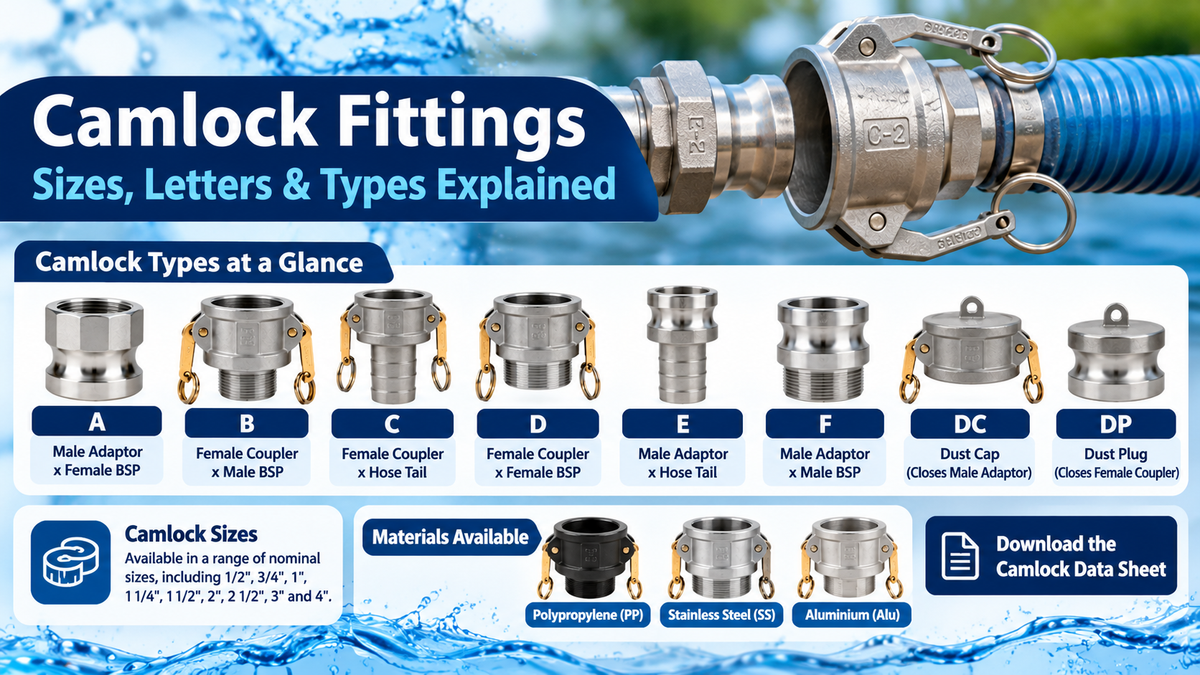
Camlock fittings are identified using letters such as A, B, C, D, E, F, DC and DP. Each letter identifies a particular connection configuration, including male or female Camlock connections, BSP threaded connections and hose tails.
In this guide, T-mex Express explains the different Camlock fitting types, Camlock sizes, connection methods and material options, helping you select the correct coupling for your application.
What Is a Camlock Fitting?
A Camlock coupling is a mechanical quick-connect fitting that allows hoses, pipes, pumps, tanks and other equipment to be connected and disconnected without specialist tools.
The Cam and Groove system consists of two main components: a male Camlock adaptor (plug) and a female Camlock coupler.
The male adaptor is inserted into the female coupling, where two cam arms are closed to secure the connection. A sealing gasket inside the female coupling provides the seal between the two components.
This quick-release connection makes Camlock fittings particularly useful where hoses and pipework need to be frequently connected, removed or changed.
Benefits of Camlock Fittings
- Quick connection and disconnection without specialist tools
- Available in a wide range of sizes and materials
- Suitable for hoses, pumps, tanks and pipework
- Can reduce downtime during hose changes
- Simple mechanical locking-arm operation
- Available with BSP threaded and hose tail connections
- Widely used in agricultural and industrial fluid transfer
Camlock Fitting Letters Explained – A, B, C, D, E, F, DC & DP
Camlock fittings use a standard letter identification system to describe the connection at each end of the fitting.
The following Camlock type chart explains the differences between each connection.
| Camlock Type | Camlock Connection | Other Connection | Description |
|---|---|---|---|
| A | Male Plug | Female BSP | Male Camlock adaptor with female BSP thread |
| B | Female Coupler | Male BSP | Female Camlock coupler with male BSP thread |
| C | Female Coupler | Hose Tail | Female Camlock coupler with hose tail |
| D | Female Coupler | Female BSP | Female Camlock coupler with female BSP thread |
| E | Male Plug | Hose Tail | Male Camlock adaptor with hose tail |
| F | Male Plug | Male BSP | Male Camlock adaptor with male BSP thread |
| DC | Female Coupler | Dust Cap | Cap used to close a male Camlock adaptor |
| DP | Male Plug | Dust Plug | Plug used to close a female Camlock coupler |
Important: Camlock letters identify the fitting configuration, not its size or material. For example, a Type C Camlock is always a female Camlock coupler with a hose tail, whether manufactured from polypropylene, stainless steel or aluminium.
Which Camlock Fittings Connect Together?
Camlock fittings connect using a male adaptor and female coupler of the same nominal Camlock size.
The male Camlock plug is inserted into the female Camlock coupling, and the locking arms are closed to secure the connection.
Male Camlock Types
Types A, E and F feature male Camlock adaptors. Type DP is also a male Camlock plug, designed to close an unused female coupling.
Female Camlock Types
Types B, C and D feature female Camlock couplers with locking arms. Type DC is a female dust cap used to close an unused male adaptor.
For example, a Type E male Camlock hose tail can connect to a Type C female Camlock hose tail, provided both fittings have the same nominal Camlock connection size.
Similarly, a Type F male BSP Camlock can connect to a Type D female BSP Camlock, provided the Camlock ends are compatible.
Remember: Male Camlock adaptors connect to female Camlock couplers. Two male adaptors or two female couplers cannot connect directly.
Camlock Fitting Sizes – How Do I Measure a Camlock?
Camlock fittings are manufactured in a range of nominal sizes, commonly including 1/2", 3/4", 1", 1 1/4", 1 1/2", 2", 2 1/2", 3", 4" and larger sizes.
One important point to understand is that Camlock sizes are nominal sizes. A 2" Camlock fitting does not necessarily measure exactly 2" (50.8mm) across every part of the fitting.
The nominal Camlock size refers to the coupling connection size, rather than the overall external dimensions of the fitting.
How to Identify Your Camlock Size
- Identify the connection type: Determine whether your fitting is a male Camlock adaptor or female Camlock coupler.
- Check the nominal size: Look for any size markings on the fitting.
- Measure the fitting: Use vernier callipers to measure the relevant Camlock connection dimensions.
- Compare with the manufacturer's data sheet: Match your measurements against the correct Camlock fitting dimensions.
- Check compatibility: Ensure both fittings have matching nominal Camlock sizes and suitable sealing materials.
When replacing an existing Camlock fitting, it is important to check the actual connection dimensions rather than relying only on the approximate overall diameter.
Camlock BSP Threads – Male vs Female Connections
Many Camlock fittings use BSP (British Standard Pipe) threads to connect to pumps, valves, tanks and pipework.
BSP threads are commonly found on Camlock Types A, B, D and F.
The threaded connection can be male or female, depending on the Camlock letter.
- Type A: Female BSP thread x Male Camlock Plug
- Type B: Male BSP thread x Female Camlock Coupler
- Type D: Female BSP thread x Female Camlock Coupler
- Type F: Male BSP thread x Male Camlock Plug
BSP thread sizes are also nominal. For example, a 2" BSP male thread has an outside diameter of approximately 59.6mm, rather than 50.8mm.
Always check whether the connection requires a parallel BSPP thread or tapered BSPT thread, and use the appropriate sealing method.
Polypropylene vs Stainless Steel vs Aluminium Camlock Fittings
Camlock couplings are available in several materials. The correct material depends on the liquid being transferred, operating pressure, temperature, chemical compatibility and installation environment.
| Material | Main Benefits | Typical Applications |
|---|---|---|
| Polypropylene (PP) | Lightweight, corrosion-resistant and economical | Irrigation, water transfer and compatible chemicals |
| Stainless Steel | High strength, durability and corrosion resistance | Industrial processing, chemical transfer and demanding environments |
| Aluminium | Lightweight metal construction and good mechanical strength | Agriculture, water transfer, tankers and industrial hoses |
Polypropylene Camlock Fittings (PP)
Polypropylene Camlock fittings provide a lightweight, corrosion-resistant and cost-effective solution for connecting hoses, pumps and pipework.
PP Camlock couplings are commonly used in agricultural irrigation, water distribution and compatible chemical transfer applications.
Their lightweight construction makes them particularly suitable for portable pumping equipment and installations where hoses are frequently moved.
Shop Polypropylene Camlock Fittings →
Stainless Steel Camlock Fittings
Stainless Steel Camlock fittings offer excellent mechanical strength, durability and corrosion resistance.
Stainless steel Cam and Groove couplings are commonly selected for demanding industrial fluid-handling applications, chemical processing and environments requiring robust metal connections.
Our stainless steel Camlock range includes male and female BSP threaded adaptors, hose tail couplings, dust caps and dust plugs.
Shop Stainless Steel Camlock Fittings →
Aluminium Camlock Fittings
Aluminium Camlock fittings provide a combination of lightweight construction and good mechanical strength.
Aluminium Cam and Groove couplings are widely used in agricultural water transfer, tanker connections, pumping installations and general industrial hose systems.
Their robust metal construction makes them a popular choice for applications requiring frequent connection and disconnection.
Shop Aluminium Camlock Fittings →
Frequently Asked Questions About Camlock Fittings
What does Type A mean on a Camlock fitting?
A Type A Camlock features a male Camlock adaptor with a female BSP thread. It connects to compatible female Camlock couplers of the same nominal size.
What is the difference between Type C and Type E Camlocks?
Both Type C and Type E Camlock fittings have hose tail connections. However, Type C has a female Camlock coupler, while Type E has a male Camlock plug. These two types can connect together when the nominal Camlock sizes match.
Can stainless steel and polypropylene Camlocks connect together?
Yes, stainless steel and polypropylene Camlock fittings can often connect together when they have matching nominal Camlock sizes and compatible connection dimensions.
However, always check the manufacturer's specifications, operating pressure, temperature and chemical compatibility before combining different materials.
Are Camlock fittings interchangeable between manufacturers?
Many Camlock fittings are manufactured to recognised dimensional standards, allowing compatible fittings from different manufacturers to connect.
However, interchangeability should not be assumed without checking the dimensions, relevant standards and sealing requirements.
Can Camlock fittings be used for drinking water?
Camlock fittings should only be used for drinking water when the complete fitting assembly, including the sealing gasket, has the appropriate approval for potable water applications.
Can Camlock fittings be used under pressure?
Many Camlock fittings are designed for pressurised fluid transfer, but the maximum working pressure depends on the material, size, manufacturer and operating temperature.
Always check the manufacturer's pressure rating before use. Camlock fittings should never be connected or disconnected while the system is pressurised.
What is the difference between a Camlock dust cap and dust plug?
A Type DC dust cap fits over a male Camlock adaptor, while a Type DP dust plug fits inside a female Camlock coupler.
Both are used to help protect unused connections from dirt, dust and debris. They should not be assumed suitable for pressure retention unless specifically rated.
Find the Right Camlock Fitting at T-mex Express
T-mex Express supplies a comprehensive range of Camlock fittings, Cam and Groove couplings, BSP threaded adaptors, hose tails, dust caps and dust plugs.
Whether you need polypropylene Camlocks for irrigation, stainless steel couplings for industrial applications or aluminium Camlocks for water transfer, our range covers a wide selection of connection types and sizes.
Explore our ranges below:
For further technical information, download our Camlock data sheet.
Download Camlock Data Sheet →